


- Temple Filler Jakarta | Treatment for Hollow Temples – Ovela Clinic
- What Is Temple Filler?
- What Causes Hollow Temples?
- Why Are the Temples Important for Facial Harmony?
- Can Temple Filler Make You Look Younger?
- Can Temple Filler Look Natural?
- Who May Be Suitable for Temple Filler?
- Why Does Temple Filler Require Detailed Anatomical Knowledge?
- Why Choose Ovela Clinic for Temple Filler in Jakarta?
- Dr. Ovin Endah Lestari
- Ovela Signature Protocol
- HA Filler Options for the Temples at Ovela Clinic
- What Happens During Temple Filler Treatment at Ovela Clinic?
- Are Temple Filler Results Immediate?
- How Long Does Temple Filler Last?
- Is Temple Filler Painful?
- How Much Downtime Is There After Temple Filler?
- Temple Filler vs. Sculptra: What's the Difference?
- Temple Filler Before & After
- How Much Does Temple Filler Cost in Jakarta?
- Frequently Asked Questions About Temple Filler
- Temple Filler in Jakarta at Ovela Clinic
- Book Your Temple Filler Consultation in Jakarta
Temple Filler Jakarta | Treatment for Hollow Temples – Ovela Clinic
Temple filler is a dermal filler treatment that may help restore volume and improve the appearance of hollow temples or temporal hollowing caused by facial anatomy, volume changes, or ageing.
The temples are often overlooked when people think about facial rejuvenation.
However, when this area becomes hollow, the face may appear:
- More tired
- More gaunt or lean
- More skeletal
- Less smooth through the upper face
- More aged
At Ovela Clinic Jakarta, temple filler is not simply about “filling a hollow area.”
Treatment begins with a facial assessment to evaluate the temples as part of your overall facial contour and proportions..
With a doctor-led and trainer-led approach, your Ovela doctor assesses whether temple filler is appropriate, how the temple relates to the forehead and cheeks, and which treatment plan and filler characteristics are suitable for your individual anatomy.
Enhance, Not Change.
What Is Temple Filler?
Temple filler is a non-surgical injectable treatment used to help restore volume and improve contour in hollow or sunken temples.
One option for treating temporal hollowing is Hyaluronic Acid (HA) filler.
In suitable patients, temple filler may help:
- Restore volume to hollow temples
- Reduce a gaunt appearance in the upper face
- Create a smoother transition between the forehead, temples, and cheeks
- Improve overall facial balance
- Create a more refreshed appearance
- Restore volume subtly without changing your natural facial features
The goal is not to make the temples look “full.”
The goal is to restore volume and contour in a way that complements your individual facial anatomy.
What Causes Hollow Temples?
Hollow temples, also known as temporal hollowing, can develop for several reasons.
1. Age-Related Volume Changes
Facial ageing involves changes in multiple layers and structures of the face.
In the temporal area, changes in soft tissue and underlying structures can gradually make the temples appear more hollow.
2. Facial Structure and Genetics
Not every hollow temple is caused by ageing.
Some people naturally have more pronounced temporal hollowing from a younger age due to their facial structure and individual tissue distribution.
3. Weight Loss
Weight loss may be accompanied by changes in facial volume, including the cheeks and temples.
In some people, this can make the face appear leaner or more hollow.
4. Changes in Facial Volume
Changes in the distribution and volume of facial tissues can alter upper-face contour and make the surrounding bony structures appear more prominent.
Because the cause and degree of hollowing vary between patients, the amount of filler and treatment plan should not be the same for everyone.
Why Are the Temples Important for Facial Harmony?
When people think about facial contouring, they often focus on the nose, lips, cheeks, or chin.
However, the temples play an important role in upper-face contour and overall facial harmony..
Pronounced temple hollowing can create shadowing and interrupt the smooth transition between the forehead and cheek area.
In suitable patients, restoring volume proportionately may help create:
- A smoother upper-face contour
- A softer facial appearance
- More balanced facial proportions
- A more refreshed appearance
Temple filler should therefore not be considered as an isolated treatment.
Your doctor should also consider its relationship with the forehead, cheekbones, midface, and overall facial shape.
Can Temple Filler Make You Look Younger?
For patients with temporal volume loss, restoring volume to the temples may contribute to a more refreshed appearance.
Hollow temples can create shadows and make the upper face look more gaunt or skeletal.
Strategic volume restoration may help smooth the upper-face contour and reduce some of this hollow appearance.
However, filler does not stop the ageing process, and the effect is different for every patient.
Treatment goals should be based on your individual anatomy, tissue condition, and facial proportions rather than simply aiming to “look younger.”
Can Temple Filler Look Natural?
Yes, when treatment is planned according to your anatomy and facial proportions.
At Ovela Clinic, the goal of temple filler is not to create excessive fullness or dramatically change the shape of your face.
Our approach focuses on:
- Facial harmony
- Appropriate volume restoration
- Smooth upper-face contour
- Balanced proportions
- Natural-looking results
The goal is not to fill the temple. The goal is to restore balance.
Who May Be Suitable for Temple Filler?
Temple filler may be considered if you have:
- Hollow temples
- Temporal hollowing
- Upper-face volume loss
- A gaunt or hollow appearance
- Facial volume changes after weight loss
- An uneven or less smooth upper-face contour
- A preference for a non-surgical approach to volume restoration
However, not every hollow temple automatically needs filler.
A medical and facial assessment is needed to determine whether temple filler is appropriate for your anatomy, medical history, tissue condition, and treatment goals.
Why Does Temple Filler Require Detailed Anatomical Knowledge?
The temple is an anatomically complex area, containing multiple tissue layers as well as important blood vessels and nerves.
Temple filler is therefore not simply a matter of adding volume to a hollow area.
Treatment planning may take into consideration:
- Individual anatomy
- Location and degree of temporal hollowing
- Injection plane
- Product characteristics
- Injection technique
- Amount of volume required
- Potential risks
Like other dermal filler procedures, temple filler carries potential risks.
Temporary effects may include swelling, bruising, tenderness, redness, or discomfort. More serious complications, including vascular occlusion, can occur, although they are uncommon.
For this reason, understanding facial anatomy, appropriate patient and product selection, injection technique, and the ability to recognise and manage complications are important aspects of temple filler treatment.
Why Choose Ovela Clinic for Temple Filler in Jakarta?
A Trainer-Led Aesthetic Clinic
Ovela Clinic uses a trainer-led approach to injectable aesthetics.
We do not view temple filler as simply deciding how many syringes should be injected.
Treatment starts with:
Assessment → Anatomy → Treatment Planning → Product Selection → Injection Technique → Follow-up
This is particularly important in the temple area because every patient may have different:
- Degrees of temporal hollowing
- Facial proportions
- Tissue characteristics
- Treatment goals
This is why, Temple filler at Ovela is therefore planned around the individual face rather than using the same treatment template for every patient.
Dr. Ovin Endah Lestari
Dr. Ovin Endah Lestari is a Restylane National Trainer for Indonesia and has experience in injectable aesthetic treatments since 2011.
Her experience as a trainer contributes to Ovela's approach to facial assessment, treatment planning, product selection, and injectable aesthetics.
Ovela Signature Protocol
Ovela Clinic uses a Ovela Signature Protocol as part of its approach to aesthetic treatments.
Doctors practising at Ovela understand and apply the same core principles, while treatment remains personalised according to each patient's facial anatomy, tissue condition, and aesthetic goals.
This means Ovela's approach is not dependent on a single doctor.
Dr. Ajeng, with more than 12 years of experience, also understands the Ovela Signature Protocol and applies its principles in her practice.
Being trainer-led does not mean every patient receives the same treatment.
Instead, the Ovela Signature Protocol provides a consistent framework for assessment, treatment planning, and aesthetic principles, while the technique, treatment area, product, filler amount, and desired outcome remain individualised.
Consistent principles. Personalized treatment. Natural results.
HA Filler Options for the Temples at Ovela Clinic
Ovela Clinic offers several Hyaluronic Acid (HA) filler options, including Restylane and Juvéderm.
There is no single filler product that is automatically the right choice for every patient.
Product selection may take into account:
- Facial anatomy
- Current tissue condition
- Degree of temporal hollowing
- Treatment area and plane
- Filler characteristics
- Amount of volume required
- Injection technique
- Desired outcome
You therefore do not need to arrive at your appointment having already chosen a specific filler brand or number of syringes.
What matters more is determining a treatment plan that suits your anatomy and individual facial needs.
What Happens During Temple Filler Treatment at Ovela Clinic?
1. Facial Assessment
Your doctor evaluates the temples as part of your overall facial structure, including:
- Degree of temporal hollowing
- Forehead contour
- Cheek and cheekbone
- Facial symmetry
- Volume distribution
- Overall facial proportions
2. Personalized Treatment Planning
Your doctor determines whether filler is appropriate and develops a treatment plan based on your anatomy and aesthetic goals.
3. Product Selection
The HA filler is selected according to your tissue characteristics, anatomy, and treatment plan.
4. Skin Preparation
The treatment area is cleansed and prepared before injection. A topical anaesthetic may be used when appropriate to improve comfort.
5. Filler Injection
Filler is administered using a technique selected by your doctor based on your individual anatomy and treatment plan.
6. Final Assessment
After treatment, your doctor evaluates the contour, symmetry, and overall facial balance.
Are Temple Filler Results Immediate?
Some changes in volume and contour may be visible immediately after treatment.
However, temporary swelling and other post-injection changes may affect the initial appearance.
The way your temples look immediately after treatment may therefore differ from the final appearance once the area has started to settle.
How Long Does Temple Filler Last?
The longevity of temple filler varies between individuals.
In general, results may last approximately 9–18 months, although this can vary depending on:
- Filler product
- Amount used
- Individual anatomy
- Metabolisme
- Treatment technique
- Lifestyle
- Individual response to the filler
Your doctor can provide a more relevant estimate once the product and treatment plan have been determined.
Is Temple Filler Painful?
Treatment sensations vary between patients.
You may experience pressure, an injection sensation, or temporary discomfort during the procedure.
A topical anaesthetic may be used when appropriate to improve comfort.
How Much Downtime Is There After Temple Filler?
Some patients may experience temporary:
- Swelling
- Redness
- Bruising
- Tenderness or discomfort
Many patients are able to return to normal daily activities after treatment, although individual experiences vary.
Your doctor will provide specific aftercare instructions based on your procedure.
Temple Filler vs. Sculptra: What's the Difference?
HA filler and Sculptra work differently.
HA filler provides volume and structural correction more directly.
Sculptra (PLLA) is a collagen biostimulator that works gradually by stimulating collagen production.
Treatment selection may depend on:
- Degree of volume loss
- Facial anatomy
- Current tissue condition
- Desired timeline
- Treatment goals
For some patients, one approach may be more appropriate than the other. In selected cases, your doctor may consider a combination approach.
[Learn More About Sculptra at Ovela Clinic]
Temple Filler Before & After
Before-and-after photos can help illustrate the types of changes that may be achieved with temple filler.
However, results vary between patients depending on anatomy, degree of temporal hollowing, filler product, amount used, injection technique, and treatment plan.
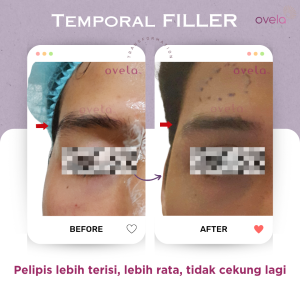
* Results for each individual may vary depending on several other factors. The information above is only a reference.
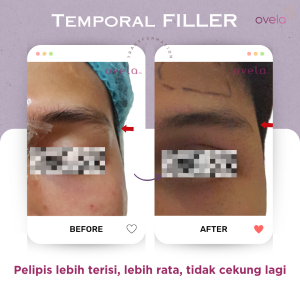
* Results for each individual may vary depending on several other factors. The information above is only a reference.
[[View Ovela Clinic Filler Before & After Gallery]]
Before-and-after images show individual treatment outcomes and should not be considered a guarantee that another patient will achieve the same result.
How Much Does Temple Filler Cost in Jakarta?
The cost of temple filler in Jakarta can vary depending on:
- Filler product
- Amount of filler required
- Degree of temporal hollowing
- Individual anatomy
- Treatment plan
The amount required may also differ between the left and right temples. For this reason, the number of syringes is best determined after an individual facial assessment.
Looking for the current temple filler price in Jakarta?
Contact Ovela Clinic for current pricing and arrange a personalised facial assessment with an Ovela doctor.
Frequently Asked Questions About Temple Filler
Can filler improve hollow temples?
Yes, in suitable patients. Dermal filler may help restore volume and improve contour in hollow temples or temporal hollowing.
Can temple filler look natural?
Yes.
When treatment is tailored to your anatomy, degree of hollowing, and overall facial proportions, temple filler can create a more balanced contour without making the area look excessively full.
How many syringes of filler do I need for my temples?
There is no standard amount for every patient.
The amount required depends on the degree of hollowing, facial anatomy, symmetry, filler product, and treatment goals.
Your doctor will determine an appropriate amount after facial assessment.
How long does temple filler last?
In general, results may last approximately 9–18 months.Longevity varies depending on the filler product, anatomy, metabolism, technique, lifestyle, and individual response.
Is temple filler safe?
Temple filler is a medical injectable procedure and carries potential risks.
The temple has complex anatomy, which is why appropriate assessment, anatomical knowledge, product selection, injection technique, and the ability to recognise and manage complications are important.
Does temple filler hurt?
You may experience pressure, an injection sensation, or temporary discomfort. A topical anaesthetic may be used when appropriate to improve comfort.
When will I see the results?
Some changes may be visible immediately after treatment. However, temporary swelling can affect the initial appearance, so the result is better assessed once the treated area begins to settle.
What is the difference between temple filler and Sculptra?
HA filler provides volume more directly, whereas Sculptra is a collagen biostimulator that produces gradual changes through collagen stimulation.
Which approach is more appropriate depends on your anatomy, tissue condition, degree of volume loss, and treatment goals.
Is temple filler suitable after weight loss?
In some patients, weight loss may be accompanied by facial volume changes, including temporal hollowing.
Filler may be considered if your facial assessment indicates that restoring volume to the temples is appropriate.
Which filler does Ovela Clinic use for the temples?
Ovela Clinic offers HA filler options including Restylane and Juvéderm.
Product selection is not based on using the same brand for every patient. Your doctor considers your anatomy, tissue characteristics, filler characteristics, treatment plan, and desired outcome.
Who performs temple filler at Ovela Clinic?
Treatment is performed by Ovela doctors who have received appropriate training and follow the Ovela Signature Protocol.
Ovela uses a trainer-led aesthetic clinic approach, with Dr. Ovin Endah Lestari as Restylane National Trainer for Indonesia.
Temple Filler in Jakarta at Ovela Clinic
If hollow temples make your face appear more gaunt, lean, or tired, temple filler may be one option to help restore facial volume and upper-face contour in suitable patients.
But treatment should not begin with:
“How many syringes of filler do I need?”
At Ovela Clinic, we start by asking:
“Why do the temples look hollow, and what treatment best suits the face as a whole?”
Your doctor assesses the temples, forehead, cheeks, facial volume distribution, symmetry, and overall facial proportions before recommending a treatment plan.
With Ovela's trainer-led aesthetic approach, Ovela Signature Protocol, and HA filler options including Restylane and Juvéderm, treatment is planned around your individual facial anatomy and goals.
Restore volume. Preserve character.
Enhance, Not Change.
Book Your Temple Filler Consultation in Jakarta
Not sure whether temple filler is the right treatment for your hollow temples?
Start with a personalised facial assessment with an Ovela doctor.
- Tebet – South Jakarta (Book Now)
- Kebon Jeruk – West Jakarta (Book Now)
Talk to an Ovela doctor to find out whether temple filler, Sculptra, or another treatment approach is more appropriate for your anatomy and aesthetic goals.
Medical Disclaimer: The information on this page is for general educational purposes and does not replace an in-person medical consultation. Treatment suitability, product selection, filler amount, injection technique, potential risks, and expected outcomes vary between individuals and should be assessed by a qualified doctor.